
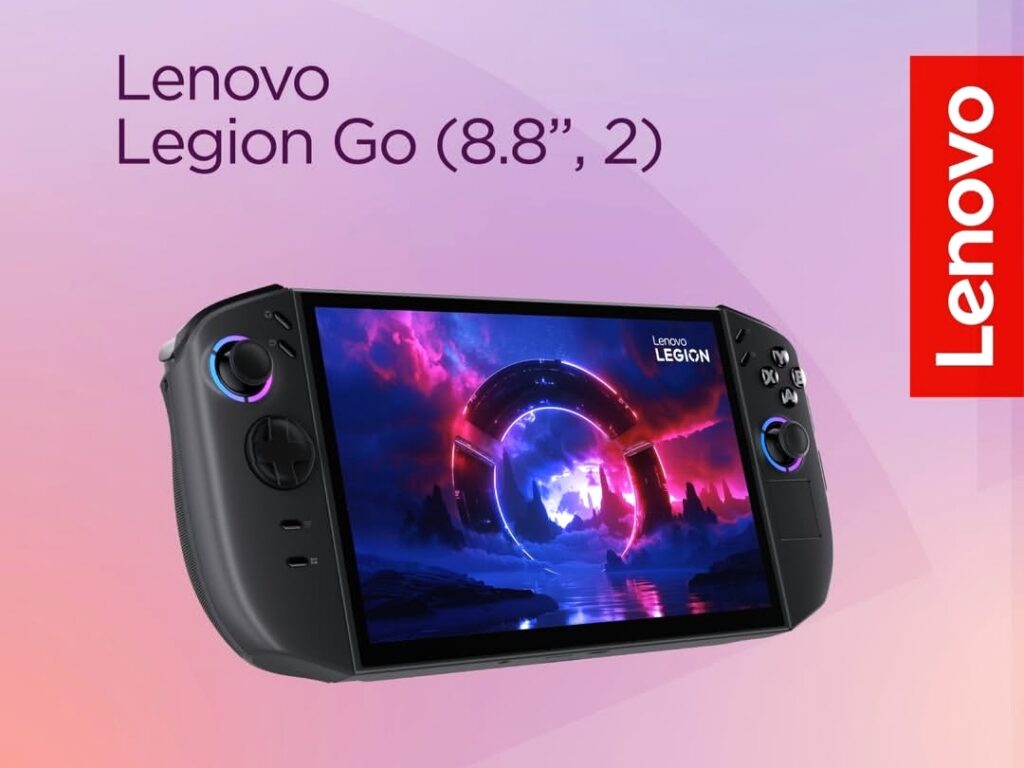
The Lenovo Legion Go Gen 2 marks the next evolution of high-performance portable gaming. With major upgrades in performance, display technology, and build quality, this second-generation handheld offers a premium PC gaming experience in a compact form factor. Often described as “the most outrageous handheld ever made,” it truly aims to set new benchmarks for power and immersion.
Core Specifications and Key Upgrades
Performance and Chipset
At the heart of the Legion Go Gen 2 lies the new Ryzen Z2 Extreme processor, engineered to deliver unmatched speed and smoothness in portable gaming. A lower-cost variant housing the standard Z2 chip is also available. Lenovo’s revamped cooling system—with oversized exhaust vents and refined airflow—keeps performance stable even under heavy loads.
Display Enhancements
The Legion Go Gen 2 replaces its IPS panel with an OLED display, offering deeper blacks and contrast that’s nothing short of stunning.
– Screen size: 8.8 inches (the largest in its class)
– Refresh rate: 144 Hz with Variable Refresh Rate (VRR) support
– Brightness: 500 nits, certified for DisplayHDR True Black 1000
Every frame looks fluid, crisp, and vibrant, making it ideal for both fast-paced shooters and cinematic AAA titles.
Resolution and Gaming Strategy
Lenovo made a strategic move by reducing the resolution from 2560×1600 to 1920×1200, optimizing for better frame rates and power efficiency. The result is smoother gaming performance without compromising clarity. The new native resolution enables full-HD gameplay without scaling issues or excessive draw on the GPU.
Battery and Power
A major physical upgrade is the 74 Wh battery — a 50% boost from the previous generation.
In practical gaming tests:
– Cyberpunk 2077 at high settings ran for 2 hours and 15 minutes (a 35% improvement over the Gen 1).
– Moderate gameplay stretches battery life beyond 3 hours, with lighter titles reaching up to 5 hours.
Real-World Performance
Across multiple benchmark titles, the Gen 2 demonstrates roughly 20–30% more power than its predecessor.
| Game | Settings | Avg FPS | Notes |
| F1 25 | 1200p, Medium | 78 | Reaches 100+ FPS when downscaled to 800p |
| Cyberpunk 2077 | 1200p, Medium | 58 | Jumps to 84 FPS at 1000p and 102 FPS at 800p |
Plugged-in performance remains optimal, as battery mode introduces a 15–20% drop depending on the game.
Design, Ergonomics, and Controls
Lenovo refines the design for better comfort and control customization:
– Rounded corners and improved grip enhance long-session ergonomics.
– Button layout minimizes mispresses and enhances tactile feel.
– Larger dual speakers and the addition of a fingerprint sensor elevate user experience.
– The True Strike controllers feature detachable versatility, ideal for FPS or strategy gaming.
The customizable Legion software allows for fan curve tuning, RGB lighting adjustments, and refined haptic feedback—giving players granular control over their experience.
However, the design still has caveats. The Gen 2 is slightly heavier and bulkier than the original (920 g), making one-handed touchscreen use less convenient. The detachable controller mechanism also remains somewhat clunky.
Software and Versatility
Running full Windows means the Legion Go Gen 2 can access Steam, Epic Games, Game Pass, and more, functioning as both a handheld console and a desktop replacement. The custom Legion Space interface helps unify the gaming experience, but the Windows environment can still feel finicky and less streamlined than console-based UI systems.
Pricing and Target Audience
The Legion Go Gen 2 starts at $1,349 (Z2 Extreme) and targets enthusiast gamers seeking desktop-grade performance in a handheld form. It’s not meant for the casual, plug-and-play experience that devices like the Steam Deck or Nintendo Switch 2 deliver. Instead, it appeals to players who demand raw power, customizability, and the best display available in any handheld gaming device.
Suggestions for the Future
Key improvement areas for the next generation include:
– Reducing the overall size and weight by about 10–15%.
– Refining the detachable controller mechanism.
– Improving software polish and stability.
With these upgrades, Lenovo could perfect what’s already one of the most powerful handheld gaming PCs on the market.

hjnh